“Gold Rush Threatens Black Hills: Open Pit Mines Could Forever Alter South Dakota’s Sacred Landscape”
American mineral production, calling for expedited permitting and reviews.
Colin Paterson, professor emeritus of geological engineering at the South Dakota School of Mines and Technology, notes that Black Hills gold is encased in rock. To extract it, the rock is crushed and then a chemical like cyanide is used to dissolve the mineral and remove it.
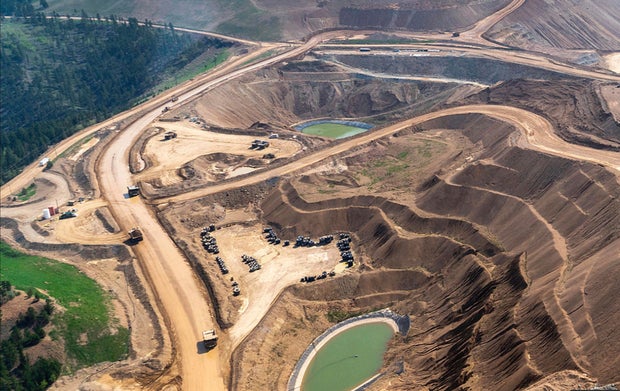
Mining brings revenue, but renews Black Hills fight
Coeur Mining runs the single active mine in the Black Hills, but the company Dakota Gold has plans for an open pit mine to begin operating in 2029. The company is also targeting the area near the old Homestake site to build an underground mine where workers would descend hundreds or even thousands of feet into shafts.
According to data provided by Dakota Gold, they believe the net present value for the deposits could range from $1.6 billion to $2.1 billion, CBS affiliate KELO-TV reported last month.
Jack Henris, president and chief operating officer of Dakota Gold, estimated the open pit mine would create up to 250 jobs and result in the company paying the state up to $400 million in taxes over the life of the mine. Dakota Gold will conduct an environmental study and surveys of soil and vegetation to ensure safe operation, Henris said.



“Most of the people that work here are from this area and just love to live here,” he said. “So we’re a big part of the Hills and we love them just as much as other folks.”

To a great extent, gold mining helped create the modern Black Hills region.
The U.S. government signed a treaty in 1868 that recognized the Sioux Nation’s right to the Black Hills, but the government seized the land after the discovery of gold and allowed settlers into the region. The U.S. Supreme Court later ruled the Sioux were entitled to compensation, but they have not accepted any and maintain their claim to the land.
Tribes have largely opposed mining in the Black Hills.
“There’s a central truth about mining in the Black Hills in that it was never the most mineral rich place there ever was,” said Taylor Gunhammer, local organizer with the Indigenous advocacy group NDN Collective and an Oglala Sioux, one of the Lakota people. “It’s not even the actual mineral content of the Black Hills that is so attractive to mining companies. It’s the permissive nature of the officials who oversee mining.”
Some proposed projects, such as Dakota Gold’s mine, are on private land and only subject to state rules, not the U.S. Forest Service regulations required for projects on public acreage.
Environmentalists have focused their opposition on the possibility of chemicals leaks. They note that Coeur’s Wharf mine has had nearly 200 spills and that the former Homestake mine was closed because it contaminated a nearby creek.

Coeur’s environmental manager, Jasmine McCauley, said in a statement that each spill was “thoroughly investigated, mitigated, and corrective actions are put in place to prevent reoccurrence.” The company is always improving its processes, she added.
Lakota People’s Law Project and the Black Hills Clean Water Alliance have also voiced opposition to the proposed drilling and mining for gold in the area, KELO-TV reported.
Jarding, of the Black Hills Clean Water Alliance, said she remains concerned about the number of projects in the works.
“It’s really important that people understand the exponential growth in mining activity that’s been happening in the Black Hills over the last five years or so,” Jarding said. “There are currently active mining claims on 271,000 acres in the Black Hills. That’s 20% of the whole Black Hills that is potentially going to be subject to mining.”